Transcript
ReachMD Announcer:
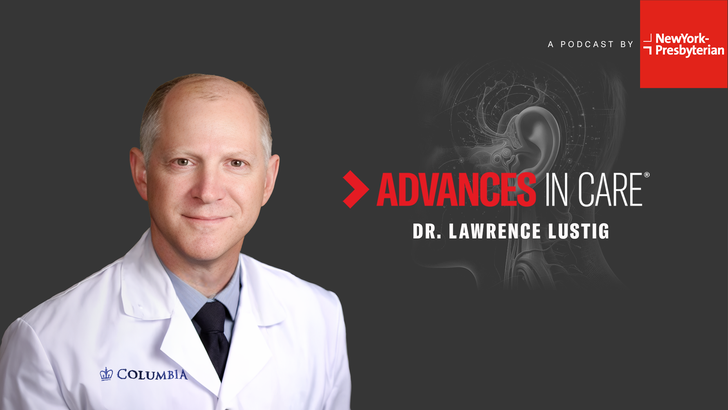
Welcome to ReachMD. This is a medical industry feature titled "Groundbreaking Gene Therapy Restores Natural Hearing for Genetic Deafness," featuring Dr. Lawrence Lustig, otolaryngologist-in-chief at NewYork-Presbyterian and Columbia. This audio is a production of NewYork-Presbyterian with world-class doctors from Columbia & Weill Cornell Medicine.
Dr. Lustig:
The genetics of deafness is very complicated. There's right now over 150 different genes that when mutated can lead to hearing loss.
Erin Welsh:
Dr. Lawrence Lustig is chair of otolaryngology, head and neck surgery at NewYork-Presbyterian and Columbia. He has spent decades working to advance therapies to treat genetic hearing loss. Historically, this type of hearing loss could only be treated with cochlear implant surgery, but Dr. Lustig was determined to find a better way. He thought that gene therapy, delivering the gene that is missing in people with genetic hearing loss directly to these patients, could be the answer.
Dr. Lustig:
In my initial kind of thought process, I was thinking I can take a kid and not have to put an electronic device in their skull for the rest of their life.
Erin Welsh:
In pursuit of that goal, Dr. Lustig's lab at NewYork-Presbyterian and Columbia was the first to show that gene therapies could effectively reverse genetic hearing loss in mouse models using a glutamate gene called VGLUT3.
Dr. Lustig:
Glutamate is the major neurotransmitter of one of the hair cells of the cochlea, the inner hair cell. It's how the hair cell talks to the auditory nerve. I think the VGLUT3 study that we did on the mice, that's really the first time people saw that you can take a mouse model and totally restore the hearing.
Erin Welsh:
After this breakthrough, he and his team faced a new challenge: Would the same mechanism work to restore natural hearing in humans with genetic hearing loss?
Dr. Lustig:
There was a gut feeling in everybody who was involved in this project that it was gonna work. It worked in the animals. It's gotta work in people. But at the end of the day, you do not know until it goes into somebody and you see what the results are.
Erin Welsh:
After years of research and clinical trials, in April 2026, the FDA approved the first-ever gene therapy for genetic deafness based on the work pushed forward by Dr. Lustig and his team.
Dr. Lustig:
When we started seeing the hearing results get better and better and better, it was jaw-dropping. None of us can believe how well these kids were hearing. To me, this has been the most gratifying stretch of my entire career, watching this whole thing unfold.
Erin Welsh:
I'm Erin Welsh, and this is Advances in Care. Today, I'll speak with Dr. Lawrence Lustig about his groundbreaking gene therapy research to restore natural hearing in patients with genetic hearing loss.
Dr. Lustig, thank you so much for joining me today.
Dr. Lustig:
It's wonderful to be here. Thanks for having me, Erin.
Erin Welsh:
So to kind of set the stage here, historically it seems that hearing loss has been difficult to address at the genetic level. What are some of the reasons for that, and when did you realize that gene therapy could be a potential solution?
Dr. Lustig:
You know, once your hair cells die, they don't regrow, so there's been a lot of efforts around the world to try to get hair cells to regrow. I think the VGLUT3 study that we did on the mice, that's really the first time I think people saw that you can take a mouse model and totally restore the hearing. The problem was VGLUT3, is not a common cause of deafness, and that's why we started going for more common causes of genetic deafness where we thought there really was good gene therapy applicability.
Erin Welsh:
So I understand that one of the first genes you looked to target was otoferlin, which is a more common cause of genetic deafness. Tell me about why this seemed like the right gene to look at in terms of keeping your eye on the goal of eventually trialing this therapy in humans.
Dr. Lustig:
So the VGLUT3, it's a synoptic protein. It involves the neurovesicular release of the neurotransmitter onto the neuron that goes to the brain, and there's something about that specific kind of mutation that does not lead initially to hair cell death or any other cellular death. So we thought synoptic proteins are gonna be the way to go here because a lot of the other mouse models we looked at, there was a lot of cellular damage. So we said, "Okay, otoferlin, it's a known cause of deafness." It creates what we call an auditory neuropathy because the specific mutation on the otoferlin gene basically cause it to make a protein that doesn't work, right? It's a null mutation, meaning there's no function of the gene. The otoferlin gene allows the synapse to release the neurotransmitter onto the afferent neuron, which goes off to the brain.
Without otoferlin, glutamate cannot be released, and it's like flipping off the light switch, and all you need is otoferlin back in the mix, and the synapse works normally. This was a target because it was synoptic protein, because there's good cellular preservation. We did get a hold of the animals and studied them, and everything looked good, and we said, "This is gonna be perfect." The problem that we had was that otoferlin's a rather large gene. It's about six and a half kilobases, whereas the viruses that we typically like to use for gene therapy for the ear, adeno-associated viruses, they have a maximum packaging capacity of about four and a half kilobases.
Erin Welsh:
Okay, so you had a problem of size on your hands. How did you address that challenge?
Dr. Lustig:
We had tried a number of things. We tried chopping the gene up into little pieces. We tried making these mini otoferlins, and we didn't get any hearing recovery. It was a bust. And then, you know, early on I had read about this new approach for larger genes, called a dual vector approach. And one of the papers I had read, they had taken this large gene called myosin 7A, which is involved in muscle function, and they cut it in half, and they engineered sticky portions on each half. So when you took and loaded each of those halves into a separate virus, and when you co-inject those viruses into a cell, the sticky portions find themselves, right? And then they cut themselves out. And now you're left with a full-length message RNA, which makes the full-length protein. It's brilliant. I loved it.
Erin Welsh:
That's brilliant. So it's like we're taking a book, we're splitting it into part one and part two, we're delivering them separately, and then you put them back together with Velcro, essentially.
Dr. Lustig:
Yeah. But then the Velcro gets cut out itself.
Erin Welsh:
And so then there's no trace.
Dr. Lustig:
There's no trace.
Erin Welsh:
Here's the full delivery of this gene.
Dr. Lustig:
Exactly. So it turns out one of the authors on that paper was the guy that was making all of our viruses for all of our other genes therapy studies. He made us the vectors, and then we tried those vectors, and it worked. And the mice heard almost completely normally again. And the big difference between this one—when we did the VGLUT3s, if we delivered about 12 days after birth, which is still considered like being in the uterus, right, we got really good hearing results. But if we did it at 21 days after birth, we didn't get any hearing results at all. So there's something that happened with the maturing ear that it didn't seem to work very well. But with the otophorin delivered later when the mice were older, they heard even better, because 30 days after birth, now you're talking about infancy, within the first six months of life. So now you've got a real potential candidate that you can move into humans.
Erin Welsh:
That must have been so exciting. And so tell me more about how the biological mechanism behind the split vector approach worked in practice. Why were these results so promising?
Dr. Lustig:
Well, I think you've got this construct that's cranking out your natural protein. It's getting to the right location. It's doing what we want it to do. We don't have worries about what's called insertional immunogenesis, meaning the gene getting into another gene and causing a problem. This is a virus that doesn't cause human disease. It seems to be extremely well-tolerated. We really saw no gene therapy-related side effects. Another really great thing about this therapy is, you know, all genes have a region of DNA called a promoter, which tells the gene when to turn on and when to turn off, and we're using a hair cell-specific promoter for the gene therapy. So even if the virus were to inject the DNA into a cell that doesn't make otophorin, it wouldn't turn on. So, there really doesn't seem to be any side effects that we've been able to detect.
Erin Welsh:
So we kind of talked about targeting this specific gene, developing this gene therapy, and then how do we get from having this gene delivered by virus into animals to then envisioning this in humans? What were the steps required for that process?
Dr. Lustig:
Oh, that part's easy.
Erin Welsh:
Oh, I'm sure.
Dr. Lustig:
Oh. So, you know, I will say, you know, the fallacy is to think, "Oh, I've got this great idea. Let's just get into people," right? Oh, then the climbing really starts, right? There are tons of preclinical studies that you have to do to make sure that it's safe, and you've gotta define how you're gonna do this very clearly to the FDA. Then you have to figure out, you know, what's the concentration of the drug that you're gonna use, right? How are we gonna get this in the ear? We decided to go through the mastoid bone like we do for a cochlear implant. You know, we gotta figure out the dosage, the concentration, you know, which age range are we gonna do? So these were countless hours of meetings with groups of docs like myself from around the country who would figure out exactly how we were gonna run this clinical trial. We published on the VGLUT3 knockout, what caused the hearing loss, I think around 2008. We did our 2012, we actually published the data on the hearing restoration in that mouse, and it wasn't till 2018 that we published the data on the otophorin knockout mouse. To me, that's a shockingly fast timeline to go from publication in a mouse model to getting into humans within about five or six years.
Erin Welsh:
Yeah. It's almost unheard of. It's amazing. So can you walk me through the steps that you took to administer the gene therapy during the clinical trial?
Dr. Lustig:
The approach we take is pretty much identical to how we do for a cochlear implant. We make a little incision behind the ear. We drill through the mastoid bone. That gets us into the middle ear. We make a very tiny opening through this little membrane called the round window membrane, put in a little catheter. We also make an accessory opening into the balance canal, because this allows us to actually flush the whole cochlear fluid and really make sure we get good delivery, and then we just flush this drug in very slowly through a micro pump for about 15 minutes. We close everything up, and then they go home. But it's not like a cochlear implant where they go home, and then three weeks later we turn on the implant, everybody's seen those videos. The kids light up. Well, this is not like that, right? It's like the ear slowly wakes up over the course of six to 12 weeks. We know from studying kinda auditory development in animals that, you know, the hair cells are actually firing nonstop during development and patterning the auditory nerve. So that hasn't happened.
So now all of a sudden, this hair cell's kinda, it's firing this neurotransmitter, and the nerve, which has gone through all of development with hearing nothing, it starts waking up. Imagine like when you fall asleep on your arm and your arm's kinda dead, right, and you open it and you kinda shake your hand, and all of a sudden you can feel again. Well, imagine that process happening over months, right? So the nerve has to wake up.
Think of all the pathways from the inner ear all the way to the auditory cortex. Those all have to wake up. Those all have to start patterning again. And at one point, I remember the mom calling me and saying, "Oh my God, my kids are running out of the house screaming." Or someone turned their head to something that dropped on the floor. You know, these unexpected things, and then to watch the hearing gradually get better and better and better.
Erin Welsh:
I mean, that is so exciting that during the clinical trial you saw results like these coming in, and it really showed what an impact this could have on people. And so can you tell me more about the role that NewYork-Presbyterian and Columbia played in developing, launching, and executing the clinical trial?
Dr. Lustig:
You know, there's lots of regulatory activities that have to happen to get approval for a clinical trial. But having been involved in the entire planning phase, we were, I think we were ahead of the game. We were one of the first sites that was online. Then it was just trying to find the kids, right? That's one of the great things about being in a large academic medical center like NewYork-Presbyterian. You've got an amazing patient population that draws patients from not only all over the country, but all over the world. We had been marketing and talking to everybody about this, and you know, "If you have an otoferlin kid, please send them to us." And so we actually had three kids identified very early on. In fact, we did more kids at our center than any other center in the US because I think we were so early on the ball on this and outreaching so extensively. I think that's what sort of helped get these three kids in here.
And you know, the first family was an older sister and a younger brother, and the family was not interested in a cochlear implant. They didn't really feel that that was their pathway. They were gonna send these kids to deaf school, but then they heard about the gene therapy. I reached out to them when I heard about the mutation. I was hooked up through their otolaryngologist up in Upstate New York, and then the family decided they wanna do it.
Erin Welsh:
How old were these two kids?
Dr. Lustig:
They were about two and four at the time of dosing.
Erin Welsh:
And in general, what is the age ranges that you're targeting with this gene therapy?
Dr. Lustig:
My original thinking was that if you don't get to these kids by six or eight, you're not gonna get any benefit whatsoever. But in fact, what we've seen now with some of the other studies, and even people dosed as late as 21, 31 years of age, still getting some auditory benefit. The window with which we can intervene is actually much wider than we thought, but I still think that the earlier you can intervene, the better. And this is data that we know from cochlear implants. So the earlier we can put in a cochlear implant in a deaf child, the better the results that they're gonna do. I think it still is about early diagnosis and early intervention.
Erin Welsh:
So a lot of these kids, though, might be too young to be able to communicate their feelings clearly, but the families witnessing this transformation, what is that like for them?
Dr. Lustig:
It's unbelievable. One of the moms of the more recent kid that we dosed the other child at around two years of age, too, showing him dancing in and around the house and, you know, she sent me a video talking about, you know, how he's gonna hear his girlfriend say yes when he asks her to the prom. It still brings a tear to my eye, you know?
Yeah, it's kind of incredible. You can get that with a cochlear implant, right? You can get hearing and language development. But it's not natural hearing.
Erin Welsh:
Right.
Dr. Lustig:
It's not natural hearing, and you have to manage this device in your skull for the rest of your life, and to have like a single shot injection of a drug in the ear that we think will last a lifetime, I mean, that's kind of amazing.
Erin Welsh:
You know, I know that this is now an FDA-approved therapy. What are some of the results that you're seeing so far in terms of response rate?
Dr. Lustig:
Most people who, number one, if you respond within the first six weeks, your hearing's gonna probably be some of the best. We're seeing hearing in the normal range all the way to the severe range. Every study has one or two candidates that hasn't responded at all who've gone on to cochlear implants and have done as well as any cochlear implant child has done. So there doesn't seem to be a downside of doing the gene therapy in terms of being able to benefit from an alternative therapy if it doesn't work.
Interestingly, if you look at how well one ear does in the bilateral kids, meaning both ears, the other ear tends to do the same, meaning there must be some basic molecular background, a must genetic background that sort of determines how well a ear is gonna do. It doesn't seem to be technique related or anything like that in terms of the delivery. And I think the real fun is gonna be when these kids are much older, and the really fascinating kids are gonna be the one with an implant on one side and the gene therapy on the other. Then you're really gonna be able to understand what's the difference between an implant and natural hearing in those kids.
Erin Welsh:
Yes. Oh, that'll be really interesting to see. What are you most excited to see this research accomplish in the next, say, decade or so?
Dr. Lustig:
This is an amazing success, and it's a proof of concept that we can cure genetic deafness. Now, the real question is can we apply this to other forms of genetic deafness, much more common forms, things like connexins, which can account up to a quarter or a third of cases of genetic deafness out there? Now, each of these other forms have challenges that we didn't have to overcome with otoferlin, but there's a number of candidate genes that are on the chopping block right now. You know, connexin's one of them. For connexin, I know we're gonna start seeing clinical trials within the next one to two years. But for these other ones, within the next three to five years we're gonna start seeing clinical trials to see who's a candidate, who's gonna benefit. Particularly for those forms of deafness that come in later in life and we can identify them, can we intervene earlier and prevent the hearing loss that would otherwise occur and make them cochlear implant candidates? And I think that's another big area of promise. It just makes you hopeful that the next 30 years is gonna be equally transformative.
Erin Welsh:
I'm certainly hopeful after speaking with you. It is incredible to think about where this work might go. Dr. Lustig, this has been such an inspirational, thought-provoking conversation. I really, really enjoyed discussing your work with you. Thank you for joining me.
Dr. Lustig:
I've had a great time today, Erin. Thank you so much for having me on your show.
Erin Welsh:
Thanks so much to Dr. Lawrence Lustig for speaking about his truly groundbreaking work using gene therapy to restore natural hearing in patients with genetic hearing loss. I'm Erin Welsh. Advances in Care is a production of NewYork-Presbyterian Hospital. As a reminder, the views shared on this podcast solely reflect the expertise and experience of our guests. To listen to more episodes of Advances in Care, be sure to follow and subscribe on Apple Podcasts, Spotify, or wherever you get your podcasts. And to learn more about the latest medical innovations from the pioneering physicians at NewYork-Presbyterian, go to nyp.org/advances.
ReachMD Announcer:
If you missed any part of this discussion or to find other programs in this series, visit ReachMD.com/industryfeature. This is ReachMD. Be part of the knowledge.